
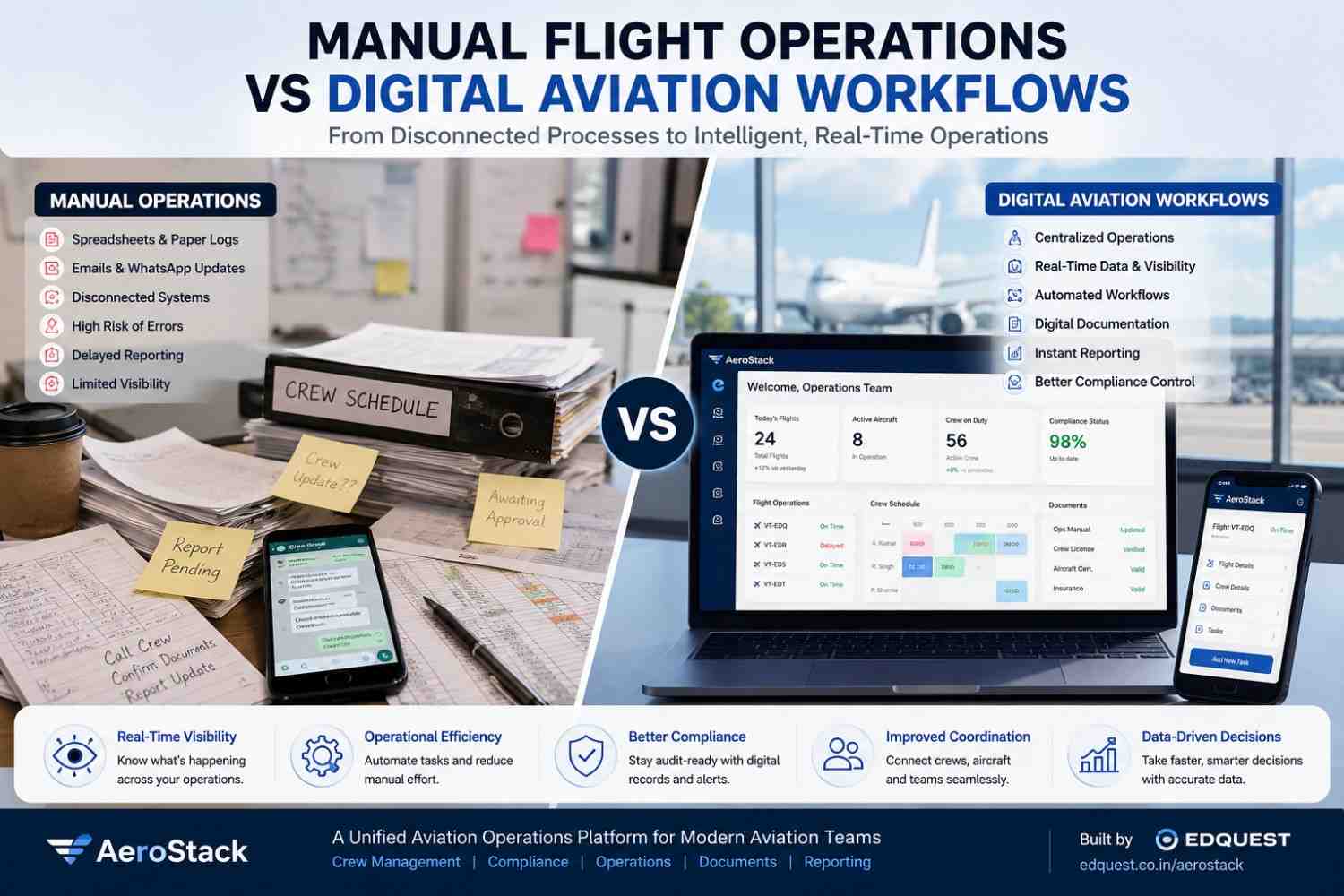
Many aviation operators — NSOPs, charter companies, and growing fleets — still run critical operations through spreadsheets, WhatsApp groups, and paper records. As fleets scale, these disconnected tools become a real operational liability. This article breaks down why modern aviation teams are moving to digital aviation workflows — and what that shift looks like in practice.
In most manual operations, crew schedules live in Excel, compliance records in folders, and flight updates in WhatsApp chats — all disconnected from each other.
A single crew change can trigger a chain of manual updates across multiple tools, creating delays and errors that compound with fleet size.
No consolidated view of aircraft status, crew assignments, or pending renewals — information must be gathered manually, taking hours instead of seconds.
Compliance, scheduling, and maintenance operate in isolation. Critical gaps often go unnoticed until an audit or an active flight.
Coordinators spend hours cross-referencing spreadsheets and compiling reports — work that grows with every aircraft added to the fleet.
Compiling operational reports from multiple sources can take half a day, with inaccuracies likely when data isn't synced.
Manually tracking license and certification expiries is error-prone. A missed renewal can ground aircraft and invite DGCA action.
Every manual entry is a risk. A wrong date or missed update can cascade into disruptions — unacceptable in a safety-critical environment.
A digital aviation operations platform consolidates crew scheduling, flight tracking, compliance monitoring, and reporting into one connected system.
For NSOP operators, this means utilizing an automated Aviation Crew Management system to perform duty-time checks, receive expiry alerts, and access DGCA-ready reporting — all from a single interface.
| Function | Manual Operations | Digital Operations |
|---|---|---|
| Crew Scheduling | Spreadsheets, updated manually | Automated with compliance validation |
| Compliance Tracking | Manual reminders, high risk of gaps | Automated alerts, audit-ready records |
| Reporting | Hours of manual data compilation | Generated in minutes from live data |
| Document Management | Physical files and scattered email | Centralized digital repository |
| Operational Visibility | Fragmented and delayed | Real-time, consolidated dashboard |
| Communication | WhatsApp groups and informal email | Structured, in-platform notifications |
| Scalability | Breaks down with fleet growth | Scales with operational complexity |
One consolidated dashboard for aircraft status, crew assignments, and compliance deadlines — no manual chasing required.
Crew replacements, compliance checks, and schedule updates handled in minutes — not half a shift.
Crew logs, flight records, and compliance docs all in one place, accessible to every authorized team member.
Automated expiry alerts for licenses and certifications — renewals flagged weeks in advance, not after the deadline.
Structured in-platform notifications replace informal WhatsApp chains, keeping every crew member on the same page.
Issues surfaced early — before they become disruptions — keeping flights on schedule and regulators satisfied.
An NSOP operator with 8 aircraft across 3 bases manages crew across 4 spreadsheets, tracks compliance in a shared doc, and spends 2 days every month compiling DGCA reports.
After moving to a centralized aviation operations platform, scheduling runs with automated compliance checks, expiry alerts fire 60 days early, and monthly reports generate in minutes.
AeroStack by Edquest is built specifically for Indian NSOP and charter operators — centralizing crew management, flight tracking, document control, and compliance in one platform.
Teams get audit-ready data, automated duty-time tracking, and DGCA-ready reporting — without the spreadsheet overhead. For operators navigating DGCA compliance, it's the infrastructure manual processes can't provide.
Aviation is moving toward fully connected digital ecosystems — where crew, aircraft, maintenance, and compliance data flow in real time across one platform.
Regulators, insurers, and partners will increasingly expect this baseline visibility. Operators who invest now will scale without adding administrative overhead.
A centralized platform managing crew scheduling, flight tracking, compliance, and reporting — replacing disconnected spreadsheets with automated, real-time workflows.
They started small where spreadsheets worked fine. As fleets grow, these tools can't keep up with compliance tracking, real-time visibility, or regulatory reporting demands.
A connected operational system where crew, compliance, flights, and reporting all share live data — replacing fragmented manual processes with one unified view.
It automates scheduling, tracks duty time against DGCA limits, flags compliance gaps early, and speeds up crew reassignment — without spreadsheet overhead.
Less admin work, fewer errors, faster reports, proactive compliance alerts, and real-time fleet visibility — all leading to smoother, faster operations.
By adopting a platform like AeroStack that gives a unified view of crews, aircraft, compliance, and reports — all in one place.
Manual processes that worked for a two-aircraft operation will break a ten-aircraft one. The shift to digital aviation workflows isn't a technology upgrade — it's a strategic necessity. The operators who move now will be the ones who scale without friction.
AeroStack by Edquest helps aviation operators move beyond spreadsheets with centralized crew management, automated compliance tracking, and real-time operational visibility.
Explore AeroStack