
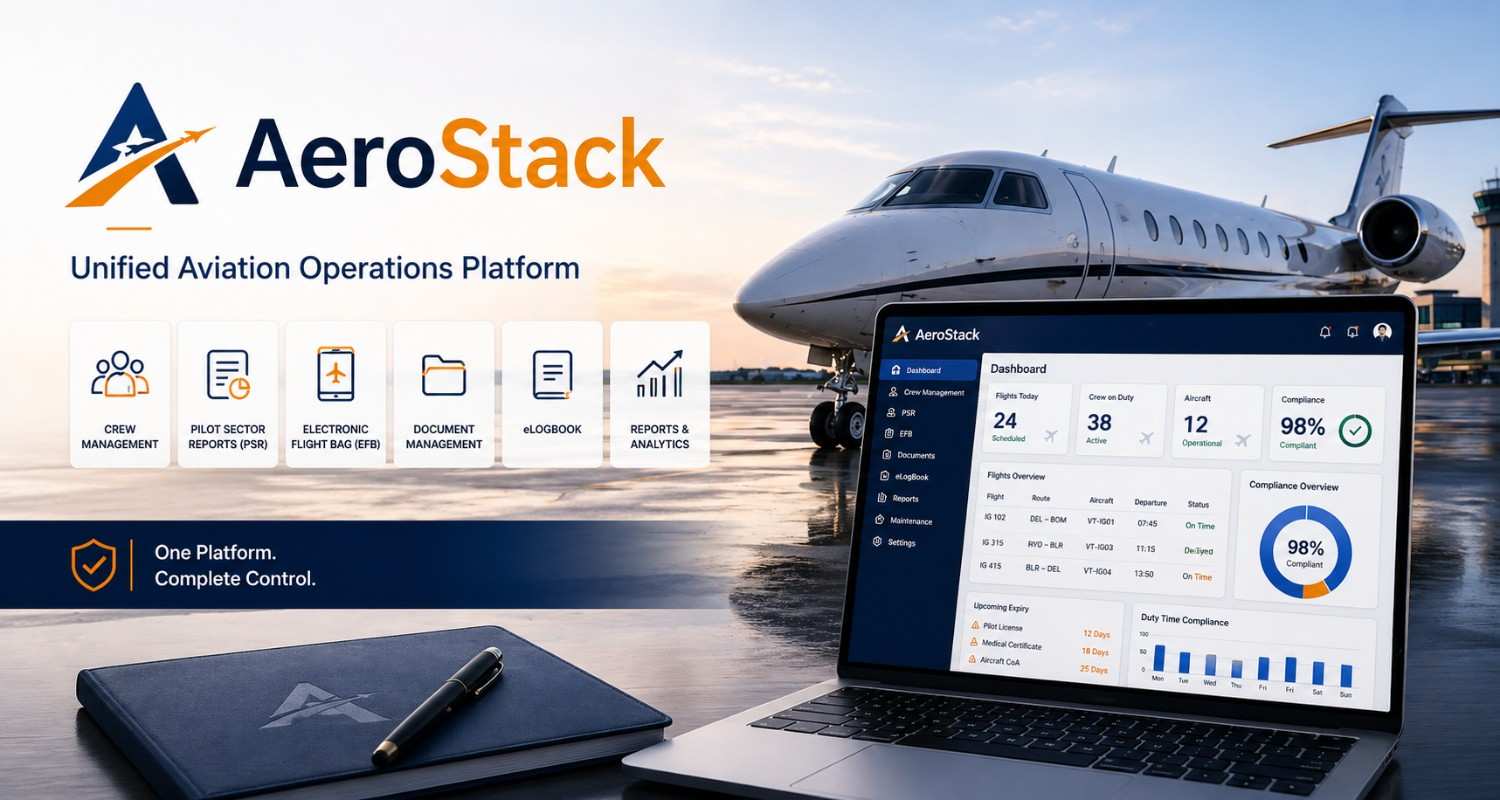
Managing aviation operations efficiently becomes increasingly complex as organizations scale. For Non-Scheduled Operator Permit (NSOP) operators, daily workflows often involve multiple operational dependencies such as crew scheduling, compliance tracking, operational reporting, aircraft documentation, flight coordination, and operational visibility. In many aviation organizations, these workflows are still managed through spreadsheets, emails, paperwork, and disconnected systems. Over time, this creates operational fragmentation, reduced visibility, and increased manual dependency. To address these challenges, we developed AeroStack — a unified aviation operations platform designed to centralize operational workflows and simplify aviation management for NSOP operators.
Aviation operations involve highly interconnected workflows where operational visibility is critical. However, many organizations face challenges such as:
Different workflows are often managed separately across spreadsheets, shared folders, manual reports, and disconnected applications. This limits centralized operational visibility.
Teams frequently spend significant time verifying operational records, coordinating crew workflows, monitoring compliance visibility, and preparing operational reports. As operations scale, manual coordination becomes increasingly difficult.
Maintaining visibility into crew certifications, operational readiness, aircraft documentation, and reporting workflows becomes operationally challenging without centralized systems.
As aviation organizations expand operations, disconnected workflows create operational inefficiencies and increase administrative complexity.
The primary objective behind AeroStack was to build a centralized aviation operations platform capable of simplifying operational coordination and improving workflow visibility. The focus was on creating a scalable ecosystem that could unify multiple aviation workflows into a connected operational environment.
AeroStack was designed as a unified aviation SaaS platform for NSOP operators and aviation organizations. Instead of operating through disconnected tools, AeroStack centralizes operational workflows into one connected platform. The system helps improve:
The Crew Management module helps centralize crew scheduling, operational assignments, certification visibility, and operational readiness tracking. This improves coordination and visibility across crew operations.
The DMS module centralizes aviation documentation workflows including operational documents, aircraft records, compliance documentation, and structured document access. This improves accessibility and operational organization.
The eLogBook module digitizes operational record management and improves centralized operational tracking workflows.
AeroStack includes centralized reporting workflows designed to improve visibility into operational activities, workflow monitoring, operational tracking, and compliance-related reporting.
From a system architecture perspective, AeroStack was designed around centralized operational visibility, modular aviation workflows, scalable architecture, structured operational coordination, and role-based operational access. The goal was to create a platform capable of supporting growing aviation operations without increasing operational complexity.
One of the biggest operational challenges in aviation is workflow fragmentation. When crew management, reporting, documentation, and compliance monitoring operate independently, operational coordination becomes significantly more difficult.
Unified aviation platforms help organizations:
By centralizing aviation workflows into a connected ecosystem, AeroStack helps organizations:
AeroStack continues evolving as a scalable aviation operations platform focused on workflow automation, operational intelligence, centralized compliance workflows, reporting optimization, and aviation operational visibility. The long-term vision is to simplify complex aviation operations through connected digital workflows and centralized operational management.
Managing aviation operations manually through fragmented systems creates operational inefficiencies and limits scalability. AeroStack was developed to simplify aviation workflows by centralizing crew management, reporting, compliance visibility, and operational coordination into one connected platform. By improving operational visibility and reducing workflow fragmentation, AeroStack helps NSOP operators move toward more scalable and efficient aviation operations.